
01
Clarify readiness
Unsure whether your experience is operating at Chartered Engineer level.
CEng Application Coaching
For many strong engineers the hardest part of CEng is not the engineering. It is turning years of real decisions and responsibility into evidence that holds up against UK-SPEC.
Independent 1:1 coaching to prepare your CEng application or Professional Review Interview, built entirely around your own work, decisions and outcomes.
Independent coaching. Massar Prime is not affiliated with the IET, Engineering Council or any professional institution.
Coaching only, not an institutional service.
Your application stays your own work and voice.
Focused on decisions, responsibility and outcomes.
The application challenge
It is a professional case that must show your engineering judgement, decisions, responsibility and outcomes clearly.
The purpose of this coaching is not to add more words to your application. It is to help you select, structure and explain the evidence that best represents your own engineering work.
Not more words. Better evidence.
Why it is worth it
CEng is an independent, internationally recognised confirmation that you work at the level of a professional engineer, assessed against UK-SPEC by a licensed institution. It is not a title you buy or a course you sit. It is earned through independent assessment against UK-SPEC, and kept through continuing membership of a licensed institution and ongoing CPD.
CEng is a professional recognition, not a shortcut. It does not by itself promise a salary, a promotion, a visa or a specific role. What it gives you is a credible, independent standard behind your name, and the clarity that comes from proving it.
Who this is for
Unsure whether your experience is operating at Chartered Engineer level.
Preparing a CEng application and need to structure your evidence.
Reviewing career history, project examples or competence evidence.
Preparing for a Professional Review Interview.
Returning after feedback, a referral or an unsuccessful outcome.
It works best when you can discuss your own decisions, responsibility and evidence in a clear, factual way.
What we work on
Review the starting point, evidence available and questions to clarify before moving forward.
Connect relevant work to competence areas without forcing a one-project-fits-all narrative.
Choose examples that show responsibility, technical judgement and credible results.
Distinguish your own remit from the wider team and project context without overstating your role.
Improve structure and traceability while keeping the application fully yours.
Prepare to explain your work in a professional discussion that can probe the full range of evidence.
Coaching is tailored to your own experience. Registration decisions remain solely with the relevant professional institution.
How it works
A free 30 minute call to confirm your stage and the right level of support.
You share your CV, role context and selected project examples.
We map your strongest examples against UK-SPEC and identify gaps.
You revise your draft using structured feedback and clear action points.
A mock interview to build clarity, depth and accountability.
Coached one-to-one by Amr Shehata, CEng MIET. About your coach
From the review desk
We designed it. We delivered it. We resolved the clash. An assessor reads the whole paragraph and never meets the engineer who wrote it.
The engineering is rarely the weak part. The applicant has disappeared inside it.
So the first piece of work is always the same. We go back through a few real projects and pull out the decision that was yours, the reasoning behind it, and what you carried afterwards.
Before
The team reviewed the contractor’s protection calculations and the discrepancy was resolved.
After
My calculations showed the contractor’s supply fuses would not clear a fault within the five seconds the code required. I raised it, the fault was traced to a defect on their side, and I signed off the amended test certificate only after re-testing.
Same project. Same engineering. Only one of them shows an engineer making a judgement and carrying it.
I hold CEng with the IET and Chartered Membership of the CIOB, and I wrote my own evidence against these same UK-SPEC headings before I reviewed anyone else’s.
That is why the coaching starts with your projects rather than a template. Looking at years of delivery and struggling to name one decision that was yours alone is a familiar place, not a theory.
Transparent 1:1 packages
Package pricing for 1:1 coaching. Official institution fees are not included.
Structure and strengthen your full application.
SAR 1,400SAR 1,000≈ $267
Two review rounds. No mock interview or presentation review.
Full support from application through to interview.
SAR 2,000SAR 1,500≈ $400
Founding offer, first 10 clients
Realistic interview practice.
SAR 850SAR 650≈ $173
One mock session.
Prices are for coaching only. They do not include any IET or Engineering Council fees, which you pay directly to the institution.
Start with a free 30 minute fit call. No pressure, no commitment.
Book the free fit callAt a glance
A quick overview of what Massar Prime CEng coaching is, and who guides it. Tap any card to read it full size.
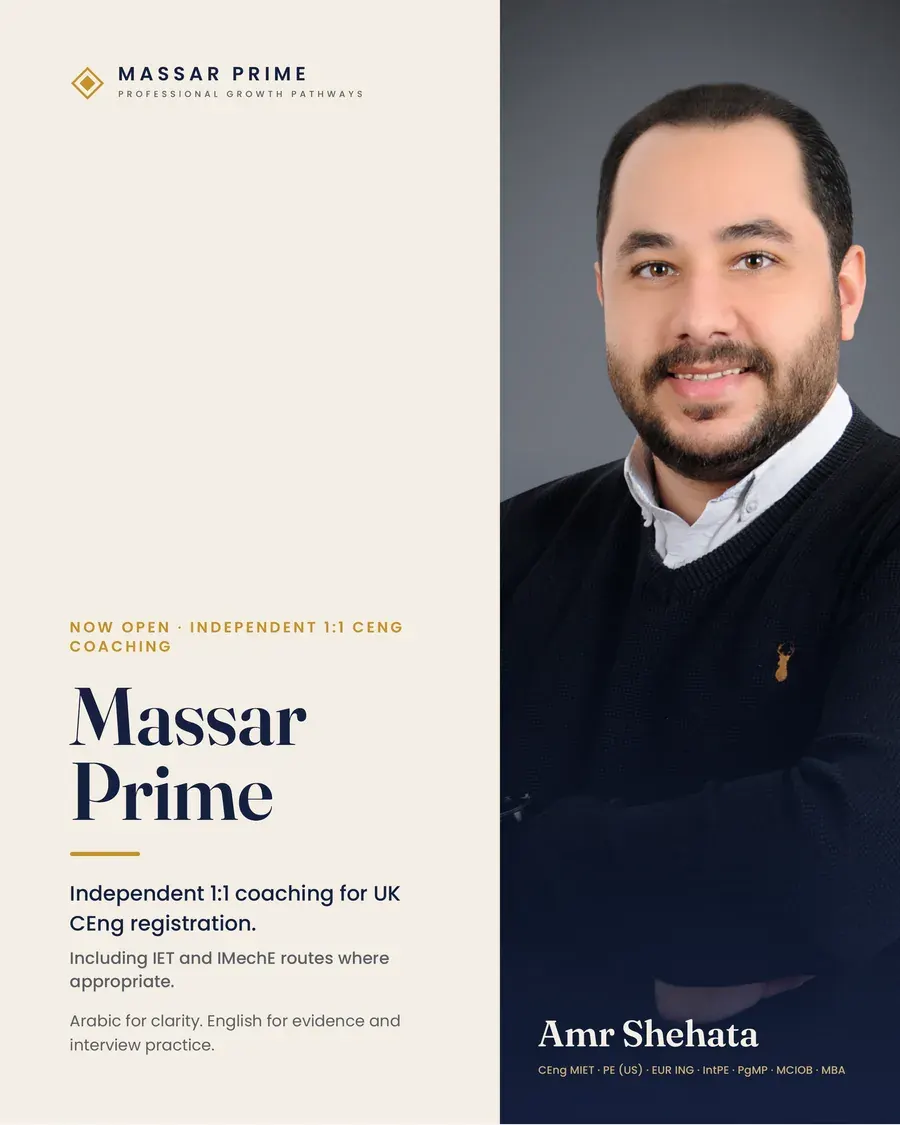
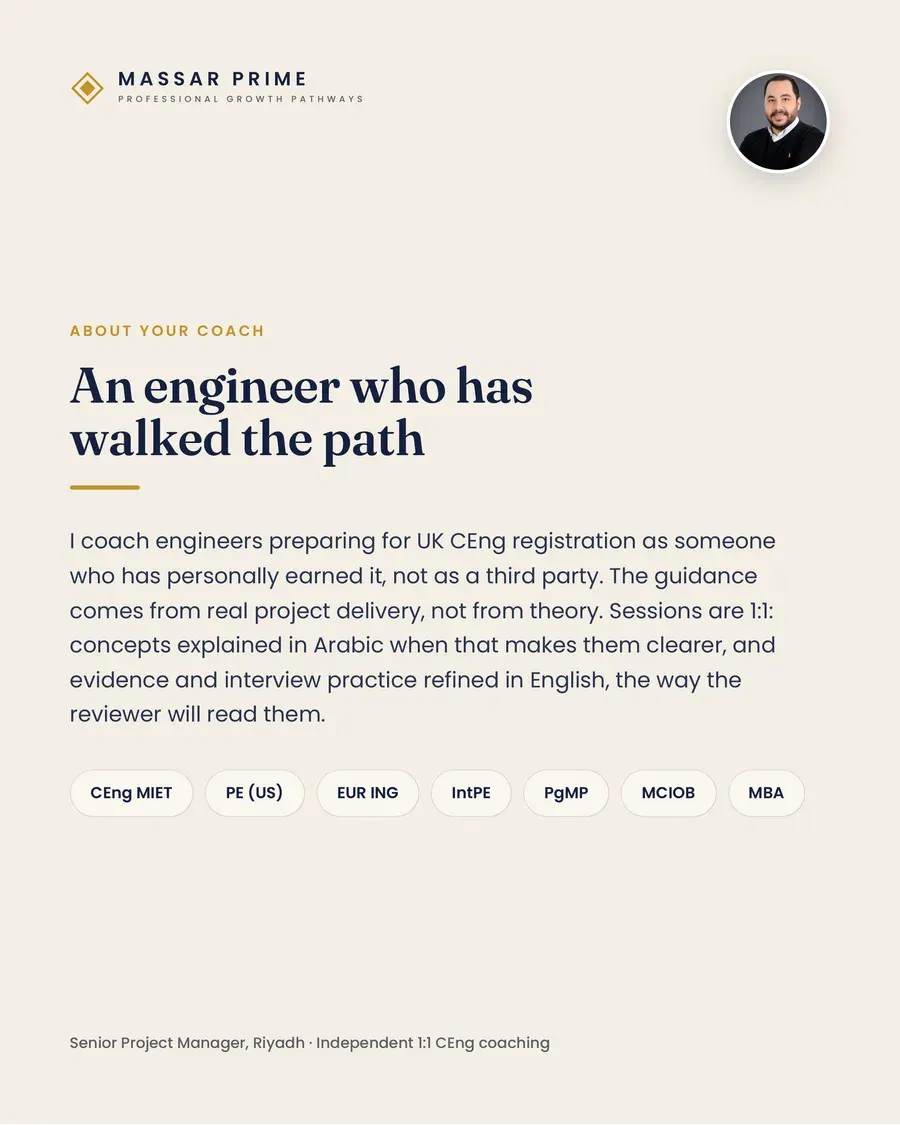
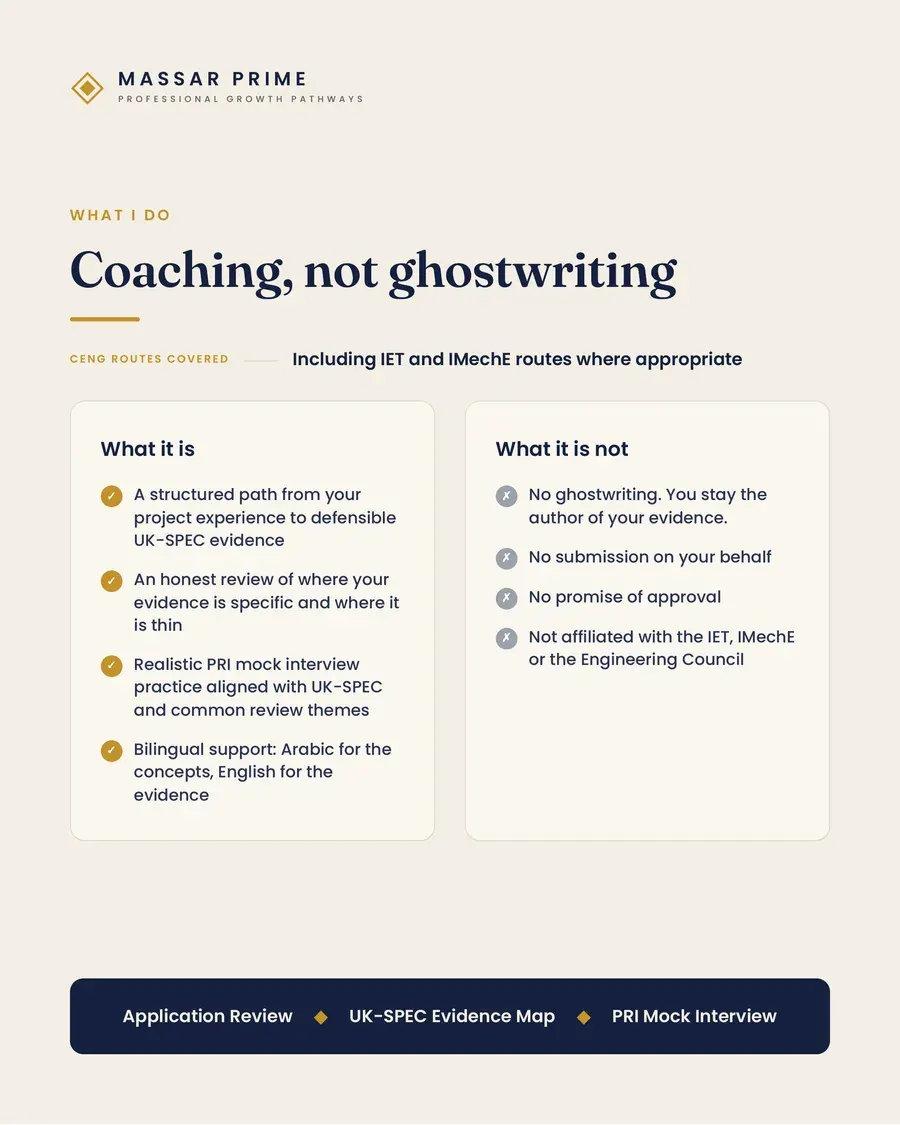

Tap any card to enlarge.
CEng or MCIOB?
Two respected routes that are often confused. They are awarded by different bodies, against different standards, for different kinds of work. The right one depends on where your responsibility actually sits, not on your job title.
| Aspect | Chartered Engineer (CEng) | CIOB Chartered Membership (MCIOB) |
|---|---|---|
| What it is | UK professional registration for engineers, awarded by a licensed engineering institution against UK-SPEC. | Chartered Membership of the Chartered Institute of Building, in construction and construction management. |
| Governing body | Engineering Council, through a licensed institution (for example IET, IMechE, ICE or CIBSE). | Chartered Institute of Building (CIOB). |
| Best suits | Professionals whose work centres on engineering judgement, design and technical decisions. | Professionals whose work centres on delivering and managing the construction process. |
| Assessed on | Competence and commitment against UK-SPEC, with a professional review. | CIOB's professional competencies, with a professional review. |
| Important | Not the same as MCIOB, and not automatically equivalent to it. | Not an Engineering Council route, and not CEng. |
Some professionals qualify for one, some for the other, and some for both. If you are unsure, a readiness review helps you decide before you commit. See MCIOB support
From LinkedIn
Practical notes on evidence, UK-SPEC and the Professional Review Interview, the same thinking behind the coaching.
Free guides
Questions that show whether your current work can be described through responsibility, engineering judgement and outcomes.
Read the guideA practical framework for turning project experience into a clear account of what you personally did, decided and learned.
Read the guideHow to prepare for a professional discussion without memorising scripts or hiding behind a team narrative.
Read the guideStart here
Tell us where you are in your CEng journey. The call is free, lasts about 30 minutes and carries no commitment. Your information is used only to respond to your enquiry and confirm which level of support fits. Massar Prime replies within 24 working hours.
Please do not include confidential employer, client or project information in this form.
Prefer WhatsApp? Fill the fields above, then tap Send my details on WhatsApp and your details come straight to Amr.
FAQ
No. Massar Prime provides independent coaching and application-preparation support. It is not affiliated with the IET, Engineering Council or any professional institution.
No. Professional registration decisions are made solely by the relevant institution and assessment panel. Coaching helps you prepare and present your own evidence clearly.
No. Your application must remain your own work. The coaching focuses on helping you identify, structure and explain your own professional evidence.
The free call is about 30 minutes and settles which level of support fits. If you go ahead, the work opens with a 60-minute diagnostic call and then moves into written rounds: you send the current version, you receive a written review, you apply it, and the cycle repeats. Each review comes back within two to three working days, so the pace is set by how quickly you can return your records. Most of the work happens in writing rather than on calls.
In four layers: a review document for the round, your own file returned with the comments marked where they belong, a sentence-level table you can search and fix directly, and separate files for the CPD and self-assessment sections. Each round ends with an action list rather than general feedback.
Competence by competence, across all seventeen sub-competences, in a separate comments file. We also decide which of your examples belong in the application itself and which sit better in the self-assessment, so the same evidence is not spent twice.
Application Review Lite includes one 60-minute diagnostic call and at least two written review rounds covering the full application. CEng Guided Path adds a presentation structure review and a 60-minute mock interview. If the application still needs work after the included rounds, that is said plainly rather than left unsaid.
Specific, and attached to your own sentences. A comment names the item, the problem and the correction. For example: abbreviations used without explanation (TAB, AHU, VFD) — write the term in full on first use, then abbreviate. Sentence-level comments give you the exact text to search for and the wording to put in its place. Anything that would not survive an assessor’s question is marked as a stop point before submission.
Four to six real professional examples from recent years, each starting with the engineering decision rather than the size of the project. Then, for each one: your role, the approximate date, the records you can produce, and the specific decision you personally made. You also need to be willing to delete any sentence you could not explain confidently in the interview.
Yes. Support can focus on understanding the feedback, identifying evidence gaps and preparing a clearer case for a future submission.
After the suitability of support and scope of work are confirmed, a secure payment link may be shared. Massar Prime does not collect card details directly through this website.
The institution's fees are separate from Massar Prime's coaching fee, and they are split across several items: the institution application or assessment fee, the Engineering Council entry and annual registration fees, and membership. The exact figures are set by each institution and change over time, so we confirm the current fees from the official source before you commit to a route.
It depends on the readiness of your evidence, document completeness, supporter response and interview scheduling. A published result usually follows within a few weeks of the interview, but that is not the same as the total time from your first enquiry. We set a realistic timeline for your specific situation.
Often, yes. A non-accredited or non-UK degree does not automatically close the door to CEng. The route depends on how the institution assesses your qualifications and your evidence, not on the name on the certificate alone. This is one of the first things we map together.
It depends on your discipline, your evidence and each institution's current route, not on your job title alone. We look at the technical decisions you actually carry before pointing you to a suitable institution and route.
No. Chartered Engineer, Incorporated Engineer and Engineering Technician are separate registration categories. IEng is not a required step before CEng. The right category depends on the level your work actually operates at, which we look at during a readiness review.
It depends on the institution. Most require at least one supporter, and often more, usually including someone who is already professionally registered. We help you work out who is suitable and how to brief them properly.
Not necessarily. The size or profile of a project does not prove your competence on its own. What matters is the decisions you personally made and the responsibility you actually held. A smaller piece of work where you led the thinking is often stronger evidence than a large project where you did not.
No. They are different frameworks. SCE is Saudi professional accreditation and practice classification; CEng is UK professional registration awarded through a licensed institution against UK-SPEC. Neither automatically converts to, or replaces, the other. Confirm your own status with the relevant body.